Voiceflow named a 2026 Best Software Award winner by G2
Read now


If you're evaluating AI for customer service, Ada shows up fast. It's one of the better-known names in automated support, and it has the customer logos to back that up. But "well-known" and "right for your team" aren't the same thing, so this is the honest version: what Ada actually is in 2026, how it prices, where users push back, and the alternatives worth a look before you sign.
One quick note before we start. Search "ada ai" and you'll get three different companies: Ada the customer-service platform (ada.cx), Ada Health (a medical symptom checker), and the American Dental Association. This review is about the first one: Ada, the AI customer service platform.
Ada is an AI-powered customer service platform built to resolve support conversations automatically. It was founded in 2016 by Mike Murchison and David Hariri in Toronto, and it serves e-commerce, financial services, healthcare, and tech companies. Brands like Square, YETI, and Monday.com run on it, and Ada says it has powered billions of customer interactions.
The thing Ada wants you to care about is its north-star metric: Automated Resolution (AR). Instead of counting how many messages the bot sent, AR measures how many customer issues it actually resolved without a human. It's a genuinely better way to think about support automation than raw deflection, and it's worth understanding the difference before you evaluate any vendor (including this one). If you've ever been burned by a vague "deflection rate" number, our piece on what ticket deflection rate actually means covers why resolution beats deflection as a metric.
Ada's automation runs on what it calls the Reasoning Engine. In plain terms, here's the loop it runs on each customer message:
It's a sensible architecture, and it maps to how most modern AI customer service agents work under the hood. The differences between vendors show up less in this loop and more in how much control, visibility, and model choice you get around it.
Beyond chat, Ada offers voice automation powered by generative AI. It's aimed at deflecting phone inquiries in the call center, the same job its chat agent does for web and messaging. Voice is increasingly table stakes for CX platforms, so it's good to see, though you'll want to test it against your actual call volume and accents before counting on it.
Here's where buyers get frustrated: Ada doesn't publish pricing. To get a number you fill out a form with your company details, monthly ticket volume, and agent count, then wait for a quote. Public signals put the entry point somewhere around $30,000 per year, with annual or multi-year commitments common at the enterprise level.
The more interesting story is how Ada charges. Ada was an early champion of outcome-based pricing, billing per resolution so you paid for results rather than seats. In practice, many enterprises pushed back: they wanted predictable budgets, so Ada shifted toward a per-conversation model, where you commit to a volume of conversations up front. It's worth knowing the distinction, because per-conversation means you can pay even when the AI doesn't solve the problem. Model your real ticket volume against whichever structure you're quoted, and if you're sizing the broader business case, our guide to calculating AI customer service ROI walks through the math.
If opaque, commitment-heavy pricing is a dealbreaker for you, that's a real reason to compare alternatives before you commit.
{{blue-cta}}
Ada's user reviews are mixed, and it's worth reading them yourself rather than taking any single score at face value. On public review sites you'll find praise for its customization and its automation depth for large support teams, alongside recurring complaints: setup and tuning can be heavy, and some users feel the bot struggles with messier, off-script questions. You can read current reviews on Trustpilot and G2 to judge fit for yourself.
That pattern (strong for structured, high-volume support; more effort for nuance) is common across enterprise CX platforms, not unique to Ada. The right question isn't "is the score good," it's "does it handle my hardest 20% of conversations."
Ada isn't the only serious option, and depending on what you're optimizing for, it may not be the best fit. A few worth comparing:
For a wider field, see our roundups of the best AI chatbots and the broader customer service automation landscape.
Both platforms automate customer service. The real difference is how much you own: the model, the logic, and the visibility into what your agent does once it's live.
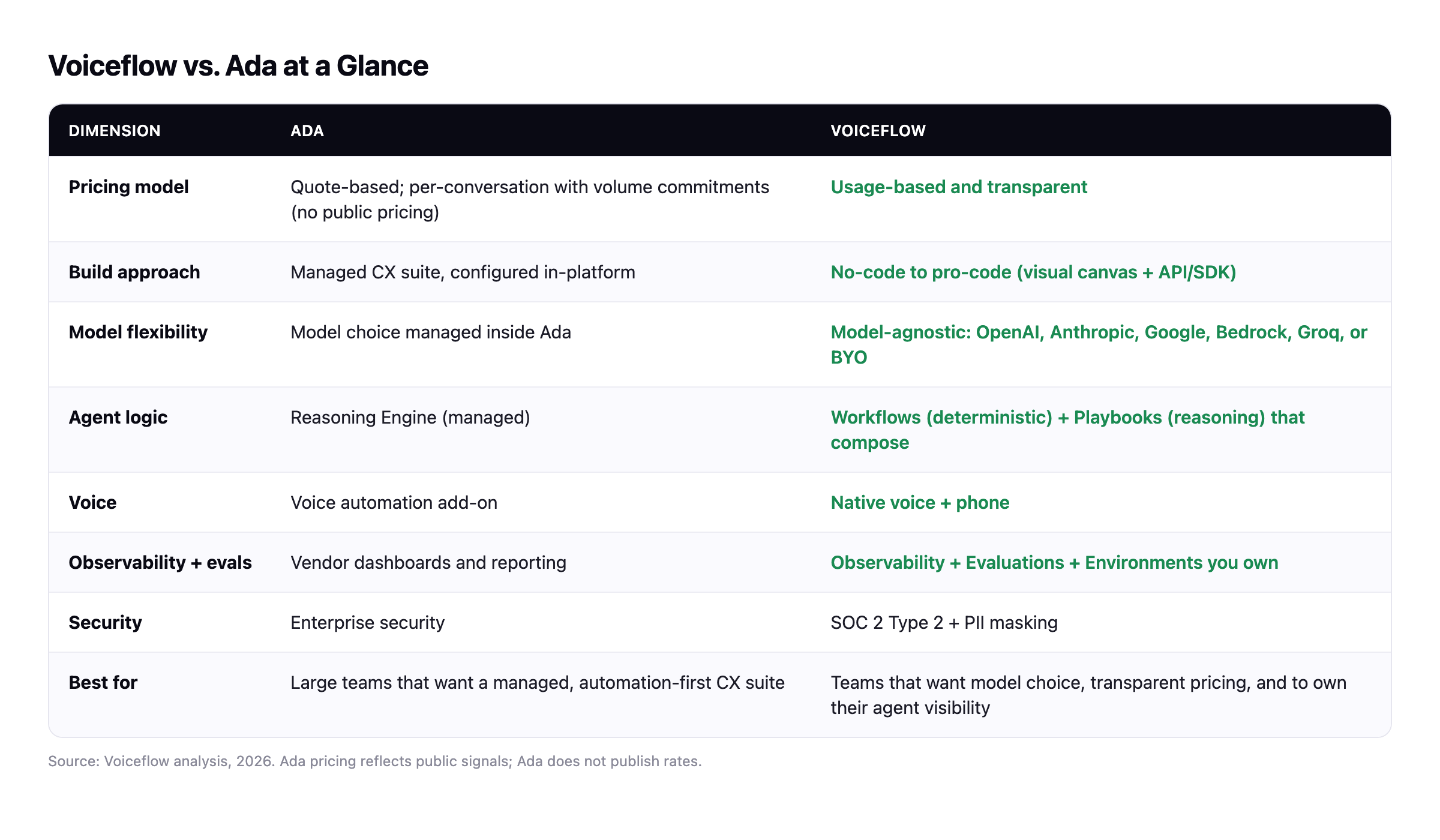
Which models you run. Ada manages model choice for you inside its platform. Voiceflow is model-agnostic by design: pick OpenAI, Anthropic, Google, Bedrock, or Groq per agent, or bring your own. If avoiding model lock-in matters, that flexibility is built in.
How the agent behaves. Voiceflow splits agent logic into two primitives that compose. Workflows are deterministic SOPs for tasks that must go right every time, like refunds or identity checks. Playbooks give the agent a goal and room to reason. A workflow can hand off to a playbook mid-conversation and back again, so the agent stays adaptable without going off-script. Good agents, like good employees, need both clear rules and room to think.
What you can see. This is the part buyers underrate. Voiceflow includes a Knowledge Base, Evaluations, and an observability suite so you can trace every conversation, define what "good" looks like, and test changes in staging before they ship. You own that visibility instead of reading it off a vendor dashboard. It's SOC 2 Type 2 compliant with PII masking, and those data-handling questions are worth weighing carefully when you evaluate any agent platform for enterprise use. For the bigger picture on where this is all heading, our 2026 contact-center landscape is a useful read.
What it costs. Ada is quote-based with volume commitments. Voiceflow is usage-based and transparent, so you're not negotiating a per-conversation rate or paying for messages that didn't resolve anything.
The honest version: if you want a managed, automation-first CX suite and you're comfortable with enterprise procurement, Ada is a credible choice. If you want model choice, transparent pricing, and to own the visibility into your own agents, that's where Voiceflow fits. Voiceflow's customers include Turo, StubHub International, Sanlam Studios, and Trilogy. To see how it handles your use case, book a demo.
{{blue-cta}}
Ada is an AI customer service platform (ada.cx) that resolves support conversations automatically across chat and voice. It was founded in 2016 in Toronto and is used by brands like Square, YETI, and Monday.com. It's a different company from Ada Health, the medical symptom-checker.
No. Ada doesn't offer a free tier and doesn't publish pricing. You request a custom quote based on your conversation volume and team size, and entry points commonly start around $30,000 per year with annual or multi-year commitments.
Ada is a private company founded by Mike Murchison and David Hariri. It reached unicorn status in 2021 after a $130 million Series C round led by Spark Capital that valued the company at $1.2 billion.
Ada is quote-based, so the exact figure depends on your volume. Public signals point to roughly $30,000 per year as a starting point. Ada historically priced per resolution and has shifted toward a per-conversation model, so confirm which structure you're being quoted before you commit.
For large support teams that want a managed, automation-first platform and can work with enterprise procurement, Ada is a credible option. If transparent pricing, model choice, and owning your own observability matter more, compare it against alternatives like Voiceflow before deciding.


.avif)
.avif)