
Voiceflow named a 2026 Best Software Award winner by G2
Read now



Generative AI has been widely adopted, but the results have been underwhelming. According to McKinsey, nearly 80 percent of companies now use generative AI, yet just as many report no meaningful impact on revenue or profitability. This is what they call the generative AI paradox: high deployment, low return.
Agentic AI offers a way forward.
Unlike traditional generative AI tools, agentic AI can take action, make decisions, and complete tasks across entire workflows. These AI agents are not just assistants that respond to prompts. They are proactive operators who drive outcomes. Businesses are already using them to automate customer service, streamline operations, and create new revenue opportunities.
To see results, companies must move beyond experimentation. This requires rethinking how work gets done, redesigning processes with AI agents at the center, and building the right infrastructure and governance to support them.
In this article, we’ll break down what agentic AI actually means, how it differs from generative AI, and, more importantly, how entrepreneurs, marketers, developers, and operations teams can start using it today to scale their business.
| Agentic AI refers to autonomous systems that can plan, reason, and act on their own to achieve specific goals.
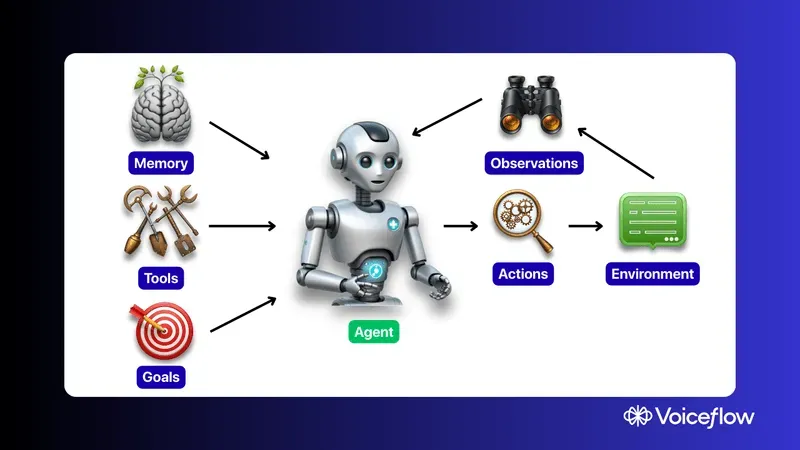
Unlike traditional AI that reacts to prompts or processes static datasets, agentic AI mimics human-like decision-making. These systems take initiatives, operate across multiple steps, and interact with tools or environments dynamically.
Imagine a customer service agent who doesn’t just answer questions but understands the user’s intent, pulls information from multiple databases, and resolves the ticket end-to-end without human input. That’s agentic AI in action.
Voiceflow's Pro Tip: Agentic AI typically combines Large Language Models (LLMs) like GPT-4 for understanding and decision-making, with specialized tools and integrations that allow it to interact with databases, APIs, and other external systems.
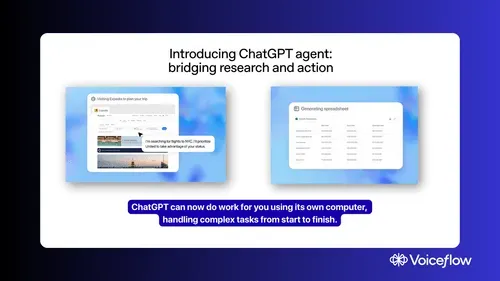
OpenAI’s ChatGPT Agent, released on July 17, 2025, is one of the first truly accessible agentic AI tools available to businesses today. Unlike traditional AI models, which passively generate text or code based on user input, the new ChatGPT Agent actively thinks and acts. It uses its own virtual computer to interact with websites, run code, access APIs, analyze documents, summarize inboxes, generate presentations, and update spreadsheets, all based on your instructions.
For businesses, this means turning hours of manual work into minutes of automation. The ChatGPT Agent can perform high-impact tasks such as:
Unlike generative AI tools, agentic AI is a structural enabler of enterprise-wide transformation. Whether you're in sales, healthcare, customer support, retail, or HR, the benefits of deploying an AI agent are clear and measurable. Below, we outline the most compelling use cases of agentic AI:
Voiceflow powers agentic AI for brands like Roam and The Institute of Human Mechanics, helping them deploy autonomous support agents that resolve issues end-to-end without human involvement. One Toronto clinic saw $50,000 in additional revenue by using a Voiceflow agent to handle after-hours patient inquiries and appointment bookings.
Salesforce is transforming sales through its Agentforce platform, which acts as an AI co-pilot that identifies leads, follows up, and even helps close deals. Meanwhile, McKinsey reports that AI-qualified leads improve conversion rates and reduce time spent on manual prospecting.
Ellipsis Health has built an “empathy engine” that speaks with patients between visits, triages risk, and alerts clinicians when intervention is needed. In another example, Propeller Health uses agentic AI in smart inhalers to analyze air quality and medication usage, alerting users and physicians in real time.
Walmart has deployed agenagentictic AI in its Intelligent Retail Lab, where robots and AI systems track inventory and restock shelves automatically.
IBM Watsonx has developed agentic HR solutions that automate everything from PTO requests to benefits inquiries.
Most people know ChatGPT, Midjourney, or DALL-E – generative AI tools that create content based on prompts. These systems are reactive: you give them a command, and they respond.
Agentic AI, on the other hand, is proactive. It makes decisions autonomously, executes multi-step tasks, and adapts to its environment. Here’s a quick comparison:
The two can also work together. For instance, an agentic AI system might use generative AI to compose a personalized message but determine when, where, and how to send it as part of a larger workflow.
{{blue-cta}}
Adaptive AI refers to systems that learn and adjust their behavior based on new data or feedback, without needing to be reprogrammed. Its “adaptive” nature simply means that the AI learns and changes.
Adaptive AI and agentic AI are not mutually exclusive. An agentic AI system might use adaptive AI models inside it to improve how it completes tasks. For instance, an AI agent that adapts its customer support strategy based on user sentiment.
You don’t need to be a developer to build a powerful AI agent. Voiceflow makes it easy. Here’s how to get started:
{{blue-cta}}
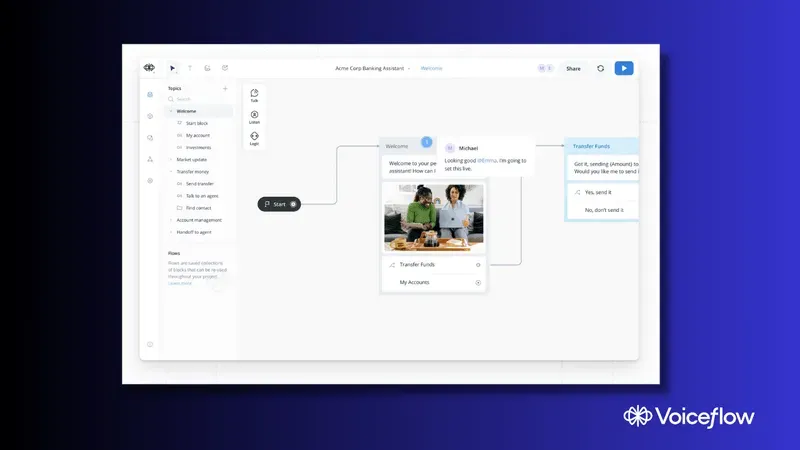
Open Voiceflow and drag your first blocks onto the canvas. These are things like messages, choices, and logic.
Use variables and conditions (“if this, then that”) to guide the conversation based on what the user says.
Want your agent to talk to Slack, Notion, or ElevenLabs? Use APIs to plug in whatever tools you already use.
Run simulations in Voiceflow to make sure your agent works exactly how you want, before it ever goes live.
That’s it! Deploy your agent anywhere: website chat, voice call, or internal tools.
Voiceflow shines by offering a unified platform for every stage of AI agent creation—from design to deployment—across both chat and voice. It empowers multidisciplinary teams, supports advanced AI models and integrations, and delivers strong ROI backed by top‑tier security and compliance.
.avif)
.avif)

